Showing posts with label buddhist tours. Show all posts

Wednesday, April 6, 2011

Mount Jiuhua, Mount Putuo, Mount Emei, Mount Wutai tour

Day 1: Singapore Guangzhou Hefei
Upon arrival at Guangzhou Baiyun Airport, take another domestic flight to Hefei, then proceed to Mount Jiuhua.
Day 2: Mount Jiuhua
After breakfast, visit Jiuhua Street, which is 600 metres above sea level and is the heart of Mount Jiuhua. Most of the temples are centralised here, hence also known as the nation of lotus and Buddha. Have a tour around Hua Cheng Temple, the main temple and the most historic one from the Jin dynasty in Mount Jiuhua. The architectural structures of the temple are built according to the shape of the mountain, hence reflecting the superb construction and design skills. Observe the Buddhist activities at night and listen to the preaching by the venerable.

Hua Cheng Temple


Hua Cheng Temple


Day 3: Mount Jiuhua
After breakfast, have a tour around the Hall of Great Vows and Tong Hui Buddhist Temple. After that, visit the Tian Tai Scenic Area (cable cars available). Tian Tai Peak is the main peak of Mount Jiuhua and is more than 1300 metres above sea level. The Yang Tze River can be seen from afar and the breeze up in the mountains is definitely refreshing. The scenery is breathtaking, hence the saying goes “if you do not mount Tian Tai Peak, it is equivalent to not coming at all”.

Tian Tai Peak


Scenery


Scenery


Scenery


Cable Car


Day 4: Mount Jiuhua Ningbo Mount Putuo
Travel to Ningbo by bus and take another bus ride of approximately 2.5 hours to Zhoushan Pier. Along the journey, the bus will pass by Zhoushan Bridge, a suspension bridge which is second only to Japan’s Akashi Kaikyo Bridge. The Zhoushan Bridge crosses four islands, nine valleys and passes through 2 tunnels. Take a 15 minutes boat ride to Mount Putuo, the only mountain of China’s four famous Buddhist Mountains that is located on the sea. Have a tour around Pu Ji Temple (Mount Putuo’s largest temple)for about 40 minutes and then have dinner. Check in to hotel after that.

Zhoushan Bridge


Pu Ji Temple


Day 5: Mount Putuo Chengdu
Visit the West Side Scenic Area after breakfast, where many interesting rock formations can be found. Have a look at the Guan Yin statue there and have a tour to Mount Putuo’s second largest temple, Fa Yu Temple. After that, take a boat ride back to Zhoushan Pier, then travel by bus to Ningbo. Have some free and easy time at China’s largest Cheng Huang Temple, which is also the largest shopping area in Ningbo, with shops and refreshments everywhere. Proceed to the airport to take a domestic flight to Chengdu.

West Side Scenic Area


Pan Tuo Rock


Bamboo Forest


Fa Yu Temple


Fa Yu Temple


Day 6: Chengdu → Leshan Mount Emei
Head to Leshan by bus, passing through Luding which is located mid-stream of Da Du River. Upon arrival, visit Luding Bridge, where the Red Army and Kuo Min Tang (KMT)’s Liu Wen Hui had a fierce battle. After lunch, visit Leshan Buddha, the world’s largest stone carving, which is also the world’s largest ancient stone carving of the Maitreya Bodhisattva. Leshan Buddha was built in AD 713 over the span of 10 years, standing at a height of 71 metres. The hair is made up of 1051 small buns, which are linked together in a way that a drainage system is created and rain water will not accumulate. Also, visit other famous sites such as the Ling Yun Temple and Ling Bao Pagoda. Proceed to Mount Emei’s market, then check in after dinner.

Luding Bridge


Ling Yun Mountain


Leshan Buddha


Ling Bao Pagoda


Day 7: Mount Emei Chengdu
Go sightseeing at Mount Emei after breakfast. Mount Emei is ranked as the China’s 4A scenic spot and is a cultural attraction. Many described the scenery on Mount Emei to be grand, elegant, wondrous and magical. Other tourist attractions such as the Golden Top and Hua Zang Temple are accessible via cable car. Head back to Chengdu by bus and have dinner. After dinner, watch the internationally acclaimed face-changing show (an expense of RMB150 per person has to be self paid). Check in to hotel after the show.

Golden Top


Hua Zang Temple


Day 8: Chengdu Taiyuan Pingyao
Take a flight to Taiyuan and visit the filming site of China’s CCTV drama hit series “Going Westward” and immerse yourself in the atmosphere as portrayed in the drama itself. The actual props used during the course of filming are also on display, bringing back memories of the scenes of the merchants’ struggles. Head over to Pingyao ancient city, a world cultural heritage site and stay at an inn for the night.

Chang's Manor


Ping Yao ancient city


Day 9: Pingyao Datong Mount Wutai
Proceed to Datong, also named “plum capital”, stopping by at a famous local specialty products shop and passing by at Yan Men Pass, one of the eight ancient passes. Have a look around Yun Gang Grotto, a highly valued treasury of stone carving art in China’s history of Buddhism and the Arts. Travel by bus to Mount Wutai, which is ranked first amongst the four famous Buddhist Mountains in China, where emperors of many dynasties had travelled to at least once. As the five peaks reach into the clouds, Mount Wutai has the reputation of having a cooling scenery. Also visit the Bodhisattva Summit and Xian Tong Temple, Mount Wutai’s largest and most ancient temple.

Yan Men Pass


Yan Men Pass


Yun Gang Grotto


Bodhisattva Summit


Xian Tong Temple


Xian Tong Temple


Day 10: Mount Wutai Datong
After breakfast, visit Mount Wutai’s most exuberant temple, the Thousand Buddha Pavilion. Also visit Chairman Mao Memorial Hall and Ta Yuan Temple, where Mount Wutai’s symbolic Sakyamuni Buddha stupa is located. Have a look around Mount Wutai Health Shop and then proceed to Dazhai and visit tourist attractions such as Dazhai Development Commemorative Hall and the tomb of China’s late deputy prime minister Chen Yong Gui. After this, return to Datong.

Thousand Buddha Pavilion


Thousand Buddha Pavilion


Ta Yuan Temple


Tiger Head Mountain


Tiger Head Mountain


Day 11: Datong → Guangzhou → Singapore
Take a domestic flight from Datong to Guangzhou, then take the flight back to Singapore.


Tuesday, February 15, 2011

Footprint of Lord Buddha 10 days tour

Day 1: Singapore → Delhi
Arrival in Delhi airport.  Upon arrival meet up with your Odyssey Manager and he will provide information about the tour and the transfer to hotel. Check in to hotel and arrange for wake up call for the early departure next morning.

Day 2: Delhi → Lucknow → Sravasti (134 km, 6.25h train ride and 4 hours bus ride)
Travel to the train station early in the morning to board the morning Shatabedi train to Lucknow. The train leaves the station at 0615 and arrives at 1230 in Lucknow.  Breakfast served on board.  Upon arrival, have lunch in Lucknow then head towards Sravasti, the capital of the ancient kingdom of Kosala which had the honour to shelter Buddha for 24 rainy seasons in the Jetvana Gardens. The city, which was believed to be found by the mythological king Sravast, has age-old stupas, majestic monasteries and several temples. Buddha was said to have performed some miracles there. Visit Saheth (Maheth and Jetvan) in the afternoon. Stay in Sravasti for the night. 
Saravasti – Jetanava Vihara Ananda bodhi tree


Day 3: Sravasti → Lumbini (Nepal) (209 km, 5h, allow extra time at the border)
After breakfast, travel to Lumbini & check in to hotel. Lumbini, the birthplace of the Buddha, was found in 1895 after being untraced for 1,500 years. Do some sightseeing around Lumbini in the evening and visit the place where Lord Buddha was born. Stay in Lumbini for the night.

Lumbini - Mahamaya Temple

Day 4: Lumbini → Kushinagar (India) (161 km, 4h, allow extra time at the border)
After breakfast, head down to Kushinagar, where Lord Buddha attained Mahaparmirvana. Amongst the ruins are the Mukutbandhan Stupa and a beautiful statue of the reclining Buddha enroute visiting Vaishali. Arrive Kushinagar and check in to hotel.
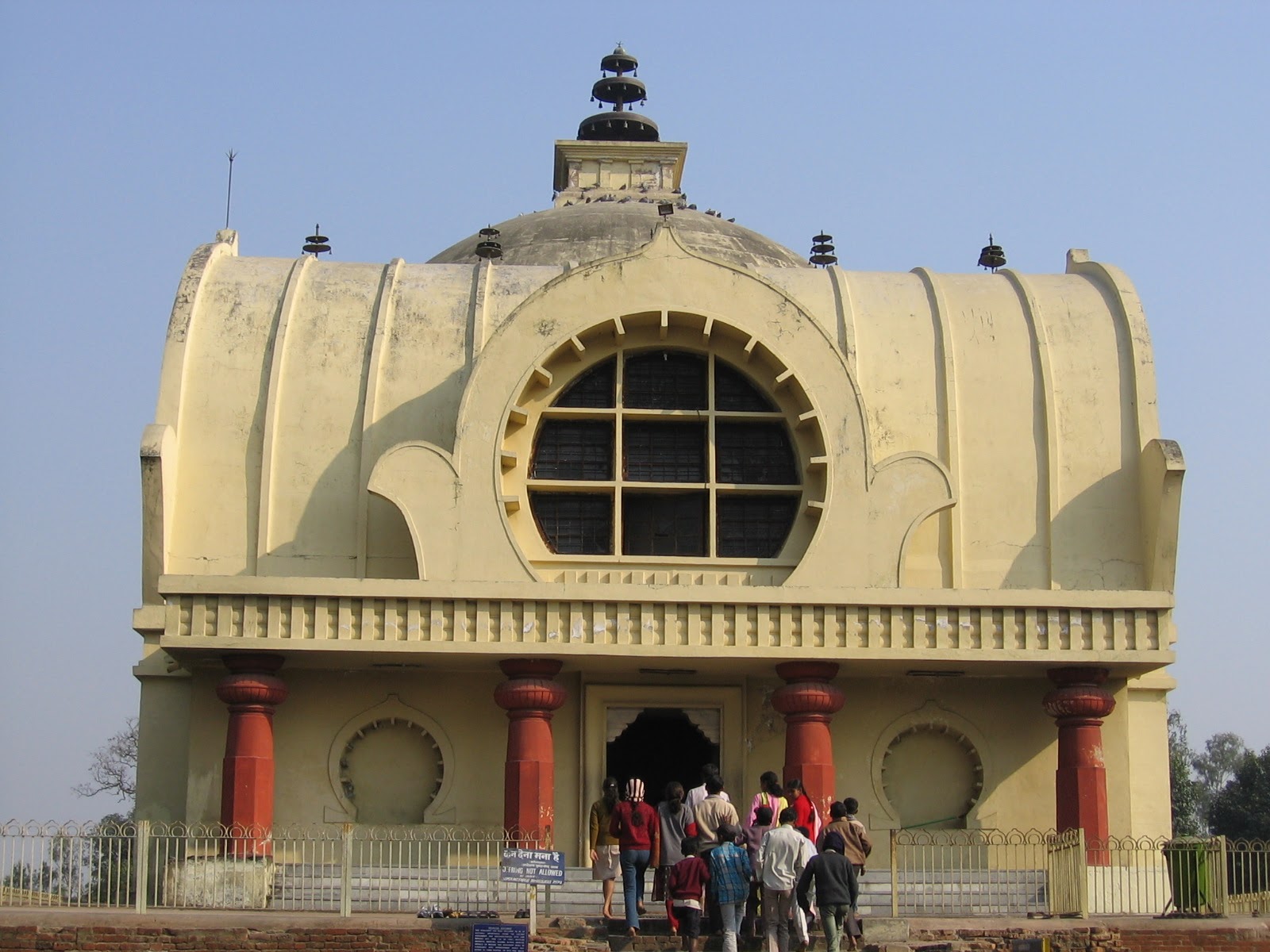
Kushinagar – Reclining Buddha Temple


Kushinagar – Reclining Buddha Temple


Day 5: Kushinagar → Vaishali → Patna (253 km, 6 hours drive and one hour visiting)
Travel to Patna after breakfast and visit Vaishali on the way.  Gautama Buddha delivered his last sermon in Vaishali and announced his Parinirvana here. Abhishek Pushkarini, the coronation tank is located 1km away. The sacred water in the tank anointed the elected representatives of Vaishali. Next to it is the Japanese temple built by the Nipponzan Myohoji sect from Japan. A small part of the Buddha's relics found in Vaishali have been enshrined in the foundation and in the chhatra of the Stupa. Near the coronation tank is Stupa 1 or the Relic Stupa. After visiting Vaishali, head for Patna and check in to hotel there.

Day 6: Patna Nalanda Rajgir Bodhgaya (198 km, 4h ride and 2-3 hours visiting time)
After breakfast, travel to Bodhgaya and take a tour around Nalanda and Rajgir on the way. Rajgir, or Rajagriha as it was known in the past (literally, the abode for kings) is surrounded by the meandering Banganga River and 5 mountains. During the lifetime of the Buddha, this was the capital of the powerful Magadhan kingdom, ruled by the virtuous King Bimbisara. The mountains and caves surrounding Rajagir served as homes to spiritual teachers, ranging from the materialism of the early Charavaka School to the metaphysics of Upanishadic philosophers. Like many others in search for truth, Prince Siddhartha, came to this city to seek the path of vation after he renounced his royal heritage. Vishwa Shanti Stupa (World Peace Pagoda) is located on Grdhakata Hill in Rajgir. Nalanda was the most renowned university in ancient India. The name was derived from Na-alam-da, which means Insatiable in Giving, one of the names Lord Buddha was known to have.
Rajgir - Vishwa Shanti Stupa on Gridhakata Hill


Nalanda – Xuan Zang Memorial Hall


Day 7: Bodhgaya
As the place of the Buddha's Enlightenment, Bodhgaya is a spiritual home for Buddhists. Bodhgaya, located near the Niranjana River, is one of the holiest Buddhist pilgrimage centres after Lord Buddha attained enlightenment under the Bodhi tree. After breakfast, visit the Mahabodhi Temple, Niranjana River and Sujata Village. Stay in Bodhgaya for the night.
Bodhgaya – Mahabodhi Pagoda


Day 8: Bodhgaya Varanasi (242km, 6h ride)
Travel to Varanasi after breakfast. Varanasi is situated on the bank of Ganges River and is the city of Shiva and the holiest for the Hindus. Varanasi is also known Benaras or Kashi. This city has been centre of learning for over 2000 years. Ganges is known as the river of salvation and many people come here before leave this world and take in their last breath so that they can leave the cycle of life, death and suffering, also known as Moksha.
Visit Sarnath in the afternoon. Sarnath is 10km Northeast of Varanasi and is the place where Lord Buddha preached for the first time after he attained enlightenment. In 3rd century BC, Ashoka the Great built stupas and monasteries and an engraved Ashoka pillar here. Muslim invaders destroyed the city and it was rediscovered by archaeologists in the 18th century. Buddhist organisations from 6 nations have built temples in Sarnath.  

Sarnath - Dhamekh Stupa


Day 9: Varanasi → Delhi → Agra
Proceed to airport in the morning to board the scheduled flight to Delhi. Upon arrival, travel 200km (about 4h) to Agra. Agra was the capital of India in the 16th and 17th century and most of the monuments and forts were built during this period. Check in to hotel for the night.
Varanasi – Ganges River


Day 10: Agra → Delhi → Singapore
After breakfast, visit Taj Mahal and Red Fort. Taj Mahal is one of the most beautiful architectural masterpieces in the world. Built entirely using white marble, Taj Mahal is regarded as one of the eight wonders of the world.  Some Western historians have noted that its architectural beauty has never been surpassed. 
Visit Agra Fort after Taj Mahal tour. The great Mughal Emperor Akbar commissioned the construction of the Agra Fort in 1565 AD, although additions were also made during of his grandson Shah Jahan’s rule. The fort has a shape of a crescent, flattened on the east with a long, nearly straight wall facing the river. It has a total perimeter of 2.4 km,being 9m wide and 10m long, and is surrounded by double castellated ramparts of red sandstone alternated at regular intervals by bastions. Deep moats also surround the outer wall. There are a number of exquisitely designed buildings located near Agra Fort such as the Moti Masjid (a white marvel mosque resembling a perfect pearl), Diwan-e-Am, Diwan-e-Khaas, Jehangir's Palace, Khaas Mahal, Shish Mahal and Musamman (also named as Samman Burj, where Shahjahan was held captive in 1666 AD). Proceed to airport in Delhi 200km away (4-5h ride) after lunch and board plane back to Singapore.
Agra – Taj Mahal


Price: approximately S$1400/person, excluding air tickets


Tuesday, January 25, 2011

Guangdong famous buddhist temples 7days 6 nights trip

Day 1: Arrival at Guangzhou Bai Yun airport in the afternoon. Go to the town area by tour bus and check in to hotel after dinner.
Day 2:
08:00 – 08:30 – Breakfast in hotel
08:30 – 12:20 – Take tour bus to Bai Yun Mountain, Guangzhou, which is Nam Yue’s famous mountain and named as most beautiful in Yang city. It is located in the north-east of Guangzhou and is the last part of the branch vein in China’s Da Yu Mountain. Bai Yun Mountain gathers over 30 peaks and is very broad, with the total area at 20.98 square metres and the tallest peak in Bai Yun Mountain, Mo Xi Peak at 382 metres above sea level. Have a look around Bai Yun Temple, which is the only temple on a mountain in the city area of Guangzhou.
12:30 – 13:30 – Lunch
14:00 – 16:00 – Visit the most established and grand Guang Xiao Temple. This temple was originally a home to Nan Yue State’s emperor Zhao Tuo‘s great-great-grandson, Zhao Jian De. During Three Kingdoms, Yu Fan, a nobleman in the Wu Country was exiled to the South China Sea, hence contemporaries named this place “garden of Yu”. It is also named as the “myrobalan forest” as many myrobalan trees are planted in the garden.
16:00 – 17:00 – Proceed to Liu Rong Temple, located on Liu Rong Road in Guangzhou city near Guang Xiao Temple. Liu Rong Temple has a long history in Guangzhou city and is famous both within the country and abroad. There are towering pagodas in the temple, as well as many historical artifacts, lush vegetation and many footprints left behind by notable people since the past. It was named by the famous Su Dongpo and is part of Guangzhou’s 4 greatest Buddhist temple integrated with jungle, together with Guang Xiao Temple, Hua Lin Temple and Hai Zhuang Temple.
17:00 – 18:30 – Dinner
19:00 – 22:30 – Night tour in Guangzhou. After the Guangzhou Asian Games 2010, Guangzhou looks totally different, with its night scene more beautiful than Hong Kong or Shanghai. (Night tour inclusive of Pearl River night cruise, stroll in Flower City Square and tour in downtown area. Self paid for climbing of Canton Tower)
22:30 – 23:00 – Return to hotel

Bai Yun Mountain


Bai Yun Temple


Guang Xiao Temple


Liu Rong Temple


Pearl River


Day 3
08:00 – 08:30 – Breakfast in hotel
08:30 – 11:30 – Travel to Zhao Qing by bus
11:30 – 12:30 – Lunch
13:00 – 18:00 – Sightseeing at Ding Hu Mountain. It is located 18km south-east of Zhao Qing city, northern latitude 23°10’, southern longitude 112°31’. As the Tropic of Cancer mostly passes through deserts and grasslands, Ding Hu Mountain is also named as the “emerald on Tropic of Cancer” by Chinese and foreign scholars. Ding Hu Mountain is the first of Ling Nan’s 4 famous mountains and is also part of Guangdong province’s 4 famous mountains, alongside Dan Xia Mountain, Luo Fu Mountain and Xi Qiao Mountain.
                                Also visit the Qing Yun Temple on Ding Hu Mountain. Located on eastern-central valley on Ding Hu Mountain, the temple possesses strong architectural characteristics of the East and is 1 of Guangzhou’s 4 renowned temples. Qing Yun temple is actually an extension of Lotus Buddhist Convent. In 1633, a monk named Zai Ji came to the Lotus peak and felt that it was a sacred land of the Buddha, hence named it the Lotus Buddhist Convent. 2 years later, Master Qi He was invited to be the abbot of Lotus Buddhist Convent. He expanded the convent to a total area of 12000 square metres, building a 5-storey hall and more than 100 sanctuaries.
18:00 – 19:30 – Dinner
20:00 – 20:30 – Return to hotel

Ding Hu Mountain


Qing Yun Temple


Day 4
08:00 – 08:30 – Breakfast
08:30 – 11:30 – Visit Seven Star Cave located 4km north of Zhao Qing city. Scenic area mainly includes Star Lake and 7 mountain peaks, which resembles the Big Dipper scattered in the lake. The Star Lake covers a total area of 6.49million square metres and the embankment is more than 20km long, clustering many small islands together, creating a pleasant scene. The local sports commission even decided to build a base for boating.
11:30 – 12:30 – Lunch
13:00 – 16:00 – Return to Guangzhou
17:00 – 18:00 – Return to hotel
18:30 – 19:30 – Dinner
19:30 – 22:00 – Free-and-easy

Day 5
08:00 – 08:30 – Breakfast
08:30 – 12:30 – Travel to Shun De by bus and visit Bao Lin Temple. The temple’s reconstruction was completed in 1998 and many believers came to worship. As the saying goes: “before Shun De had settled down, Bao Lin Temple was built”, the temple was first built between AD917-AD971 during the Nanhan period and has more than 1000 years of history to date.
12:30 – 13:30 – Lunch
14:00 – 15:00 – Visit Shun Feng Mountain Park, which is 1 of Shun De’s 10 new sceneries. Located at the foot of Tai Ping Mountain in northwest part of Shun De, the park is about 3km from the District Administration Centre and is a modernised centre for tourism, relaxation and recreation.
15:30 – 16:00 – Savour Shun De’s famous dessert ginger milk
16:00 – 18:00 – Proceed to 1 of Guangdong’s famous garden: Qing Hui Garden, which is part of the province’s heritage conservation program.
18:30 – 19:30 – Dinner
19:30 – 21:00 – Return to Guangzhou

Bao Lin Temple


Shun Feng Mountain Park


Qing Hui Garden


 Day 6
08:00 – 08:30 – Breakfast
After 08:30 – Free-and-easy, then return to hotel (expense self paid)

Day 7: Escort to airport; end of pleasant journey!

Excluding air tickets, at least 6 people and above